
Mechastructure (n.)
A modular, roboticized structural framework designed for autonomous assembly, capable of serving as both the primary structural support system and the functional machinery for large-scale infrastructures and operations.
Etymology
The term is a portmanteau of:
- Mecha (メカ): Derived from Japanese science fiction (anime/manga), referring to pilotable or autonomous giant robots. The term implies scale, mechanical complexity, and versatility.
- Structure: From the Latin structura, referring to the arrangement of elements to support a load or give form to a construction.
Conceptual Origin
The term was coined by Iok M. Wong, a former NASA engineer and founder of the startup that shared the same name, MechaStructure. The concept originated from In-Space Assembly (ISA) research aimed at enabling in-situ construction to deploy assets significantly larger than the launch vehicle’s payload fairing.
Due to the challenges of remote assembly in orbital or other planetary environments, large-scale assets must be constructed by autonomous robotic agents. In these scenarios, even some of the construction machinery, such as cranes, gantries, or ultra-long-reach robotic arms, will need to be assembled on-site by smaller, mobile robotic units.
Furthermore, assets deployed in extreme remote locations, even those classified as ‘passive static structures,’ may require system-level adjustments to fulfill mission-critical tasks.
The MechaStructure framework enables these essential active capabilities:
- Precision Pointing & Leveling: Maintaining the exact attitude and orientation required for lunar or orbital operations.
- Active Damping: Counteracting internal or external vibrations, such as seismic activity (moonquakes) or movement caused by onboard mechanical systems.
- Micro-Form Morphing: Maintaining the precise geometry of sensitive assets, such as space telescope apertures or high-gain communication reflectors.
Under the MechaStructure framework, assets of all sizes are treated as robotic platforms capable of self-assembly, autonomous maintenance, and recursive reconfiguration as needed. A defining feature of MechaStructure’s system is the ability to host robotic agents onboard, enabling sequential operations and structural-level mechatronics to ensure maximum adaptability including counteract potential anomalies throughout the asset’s operational lifespan.
Key Criteria
There are a number of key criteria that define a Mechastructure:
- Robot-Native Assembly: The robotic-structure system must be primarily assembled by, or capable of being assembled by, autonomous robotic agents without human intervention.
- Robotic Hosting Integration: The robotic-structure system shall have integrated subsystems that enable the platform to support and sustain onboard robotic agents, actuation components, sensing systems, or other controlled systems.
- Active Structural Control: The robotic-structure system shall be capable of performing some degree of mechanical work, active structural control, or sensing to ensure the integrity and functionality of the system.
- Unified Interoperability: The robotic-structure system shall possess inter-agent communication capabilities, enabling the entire collective to operate as a unified entity. The robotic-structure system shall feature standardized interfaces and protocols to communicate with external assets as a unified entity.
Precursors
While a true Mechastructure must satisfy a rigorous set of criteria, the concept is preceded by industrial systems that share many of its defining characteristics. Large-scale machinery, such as tower cranes, seaport container gantries, and bucket-wheel excavators, resembles the immense scale, structural complexity, and mechatronic integration of a Mechastructure. Historically, many of the precursors were far too massive to complete within the factory, necessitating extensive on-site manual assembly and the use of truss structures to optimize strength-to-weight efficiency.
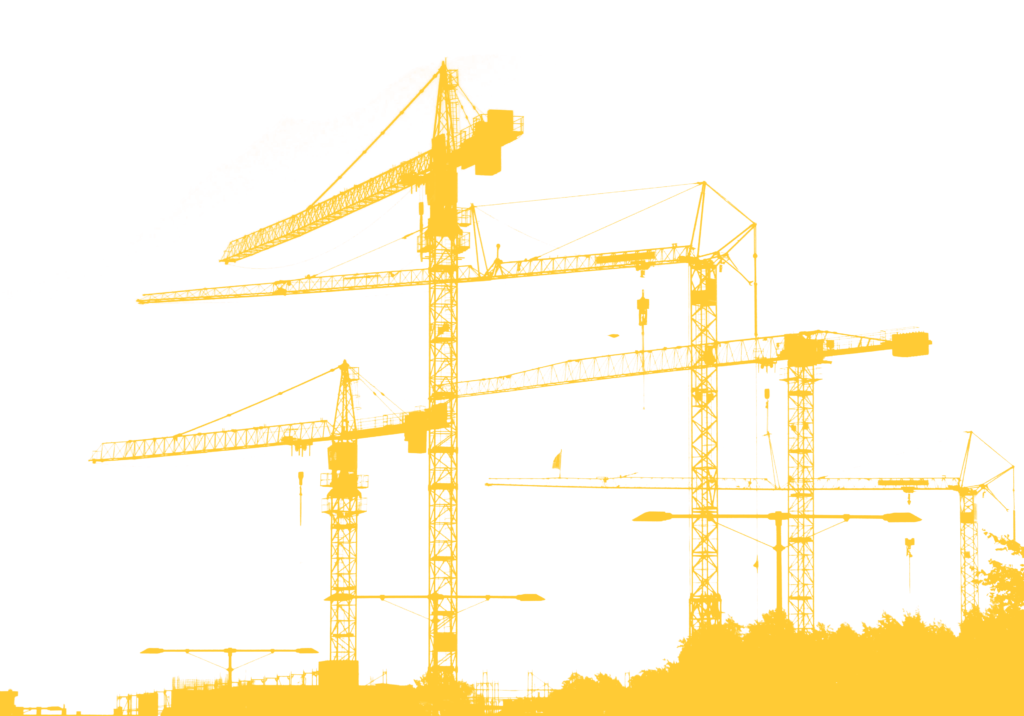
Many of existing precursor systems are also transitioning from manual operation toward greater automation via various methods, but in most cases remains focused on repetitive and highly predictable industrial tasks.
Drawing from an analysis of the functions, scale, and complexity inherent in industrial precursors, Mechastructure advances the paradigm by adopting a fully robot-native architecture to deploy large-scale assets. The Mechastructure framework provides a unified control scheme that seamlessly integrates and actuates all mechatronic subsystems within the assembled large-scale asset. In contrast to traditional precursors, a Mechastructure is explicitly designed for construction by smaller robotic agents, which ultimately merge with the structural system into a symbiotic, singular entity, functioning as a one-to-one integrated asset.
Mechastructure VS. Megastructure
While ‘Mechastructure’ and ‘megastructure’ are phonetically similar and both evoke a sense of immense scale, the two types of structure represent fundamentally different engineering philosophies. A megastructure is defined solely by its massive physical dimensions. In contrast, a Mechastructure is defined by the symbiotic relationship between the system’s robotic and structural components. The key characteristic of a Mechastructure is not merely on the final scale, but on the autonomous means of deployment and lifecycle operations.
Traditionally, a megastructure is a static entity that may or may not support auxiliary mechanical systems. These structures are typically built as an independent asset, where subsequent maintenance, modification, or system integration are treated as isolated operations unrelated to the initial construction phase.

A Mechastructure, however, is engineered as an integrated active system from inception. Even when stationary, a Mechastructure remains a responsive participant in the mission. At a minimum, every Mechastructure incorporates an embedded structural health monitoring system providing real-time telemetry. Furthermore, the Mechastructure is designed with a well defined anticipated lifecycle. Any foreseeable operations from maintenance to recursive upgrade, and sometimes a specified discommission of the Mechastructure are pre-programmed with proper protocols to ensure a reliable execution of the operation.