
The Problem:
Power, the most important resource for sustaining a persistent presence on the Moon. While several power generation technologies are under development, solar power remains the baseline for early-phase installments, providing power to a wide range of lunar operations. Even as new power generation technologies become available, lunar solar power is unlikely to be completely replaced.
Solar power is a highly mature and virtually hazard-free technology. The mass-per-watt ratio of solar towers is excellent for large-scale deployment in high-energy demand scenarios. Due to the unique geography of the Lunar South Pole, solar arrays must stand upright to maximize sun exposure. Furthermore, because of the fourteen-day lunar night, ground-level solar arrays are insufficient for sustaining continuous operations.
However, ground-level solar arrays are limited to powering lunar-day activities. Without massive batteries to store sufficient power, surviving the cold and dark lunar night will be extremely difficult, especially when the goal is to sustain a long-term human presence.
The Solution:
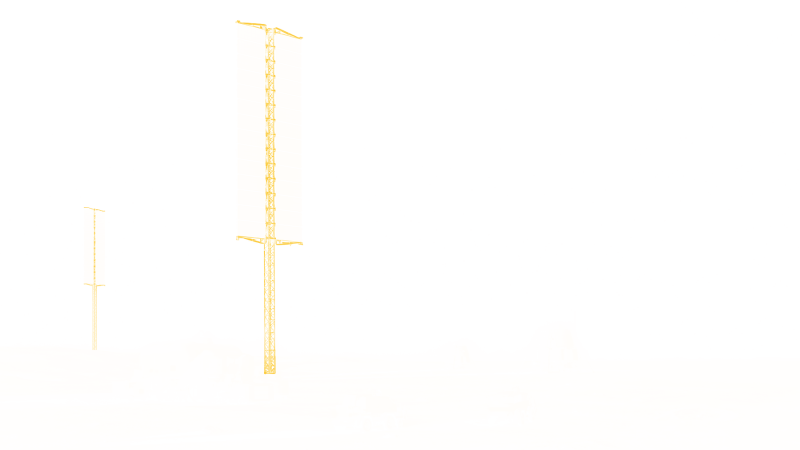
Raising the solar array by at least 50 meters, can significantly increase annual solar exposure from around 50% to as much as 90%. In other words, that means the power storage requirement for many landing areas will be reduced from fourteen Earth-days to only two Earth-days.
The solar array towers can greatly increase the area where critical assets can be deployed that require continuous operation through the lunar day-night-cycle, while greatly reducing the overall mass requirement for the mission. Besides elevating solar arrays, very tall mast structures can also host communication modules to achieve a wider range of coverage.


Figure 1: The area (yellow) receiving continuous solar exposure for energy production increases up to 26 Earth days (out of a 28-day lunar cycle) with the addition of a 50m solar tower (right), compared to the area available without a tower (left) at potential lunar landing sites. (Source: NASA)
The Offering:
MechaStructure is offering a self-assembled robotic tower structure integrated with utility lines for power and data transmission throughout the structure. The tower structure can be outfitted with solar arrays, communication modules, and other instruments to facilitate a wide range of lunar operations.
Robotic agents can navigate throughout the structure to service tall, hard-to-reach assets. Payloads can be upgraded as needed to extend the operational life of the lunar infrastructure. Serviceability is critical for large-scale solar arrays. An out-of-service array not only stops producing power but also casts a long shadow that blocks sunlight from reaching nearby arrays. Therefore, proper decommissioning is necessary if repair is no longer possible.
Robotic assembly and serviceability are standard features of MechaStructure’s robotic system, designed to handle long-term operations in extremely hazardous and remote environments.