
The Problem:
Conventional chemical rockets are effective for Earth-to-orbit launches and lunar transit, yet these rockets face fundamental limitations regarding interplanetary travel. Specifically, the achievable Specific Impulse of chemical propulsion is insufficient to meet the demands of long-distance, consistent, or high-mass payload transportation.
To overcome these limitations, several interplanetary transit and circumlunar vehicle architectures have been conceptualized. These designs often require immense structures to host or isolate critical components, such as large-scale solar arrays, thermal radiators, or nuclear reactors.
Deploying these massive structures presents a significant challenge with no easy to adopt economical options available to make these advanced concepts practically viable. Beyond the initial deployment, certain spacecraft architectures would benefit from autonomous reconfiguration to better suit the varying stages of a mission, such as transitioning from departure to cruise or arrival phases.
The Solution:
Interplanetary and circumlunar architectures, such as Nuclear Electric Propulsion and Circumlunar Solar Tugs, offer significant advantages over conventional chemical rockets. Nuclear Electric Propulsion provides an exceptionally fuel-efficient, high-specific-impulse solution for transporting heavy payloads across interplanetary distances. Conversely, the Circumlunar Solar Tugs is designed for periodic transit between Earth and the Moon, aggregating cargo in Low Earth Orbit and delivering the cargo to lunar orbit, thereby capitalizing on the high-frequency launch capabilities of Earth-to-Low Earth Orbit providers.
Both Nuclear Electric Propulsion and Circumlunar Solar Tugs architectures are payload-centric transport. By utilizing high-specific-impulse propulsion and reusable orbital transit loops, these systems decouple the propellant mass from the mission architecture, significantly reducing the ‘propellant fraction’ and maximizing the mass-delivery efficiency for high-value cargo.
The Offering:
MechaStructure provides the in-space assembly capabilities and structural systems necessary to commission, integrate, and prepare large-scale Interplanetary Transit Spacecraft in orbit. By leveraging high-cadence, multi-launch capabilities, the MechaStructure framework enables the incremental assembly of mission-critical hardware and payload stowage, bypassing the fairing constraints of any single launch.
Nuclear Electric Propulsion typically requires an extensive boom, often exceeding 50 meters in crewed or high-power designs, to achieve the necessary separation for radiation isolation. The separation distance ensures critical systems remain fully within the ‘radiation shadow’ cast by the directional reactor shield.
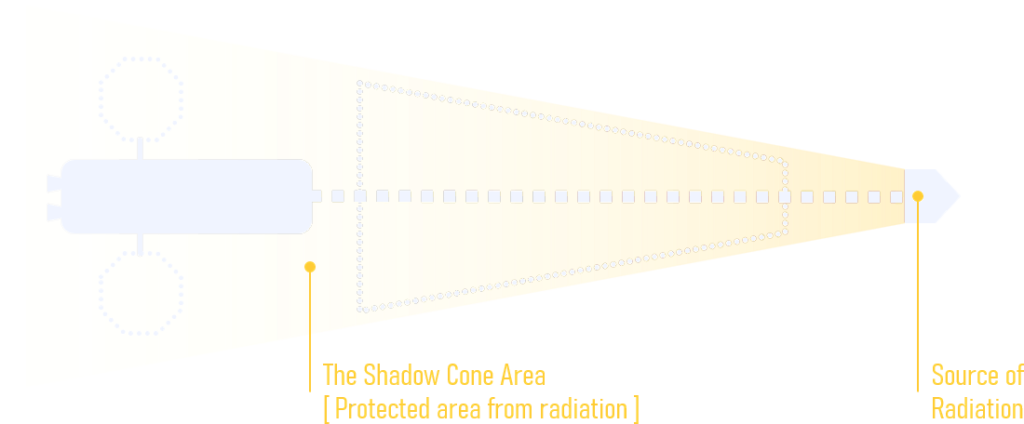
MechaStructure’s modular robotic-system in-space assembly framework can construct the linear boom truss structure, and outfitted the truss structure with deployable surface components, including thermal rejection radiators and high-output solar arrays.
Furthermore, the MechaStructure framework enables system-level reconfigurability, allowing high-value assets to be relocated and repurposed to maximize the asset functional utility. A nuclear reactor, for instance, can be decoupled from an interplanetary transit vehicle and redeployed to provide surface power or energize critical orbital infrastructure.
MechaStructure offers a universal robotic-structure platform combining high-stiffness structure with active vibration control, integrated health monitoring, and standardized attachment interfaces to support a diverse range of interplanetary mission profiles.